Overview
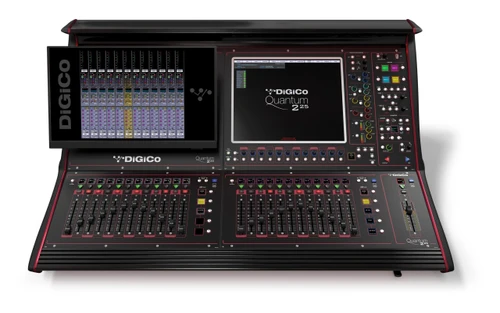
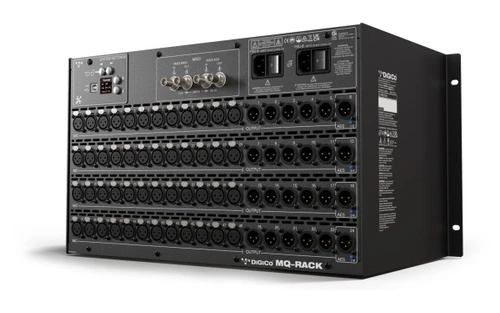
The DiGiCo Quantum 225 DS MQ-Rack Package pairs the dual screen Quantum 225 DS console with the MQ-Rack stage rack over MADI. The rack plugs straight into the console's built in BNC MADI ports, so there is no interface card to add and no network to set up, which makes it the quickest Quantum system to deploy.
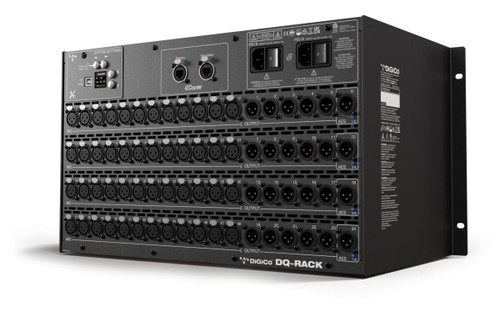
The 225 DS replaces the standard Quantum 225's left side bracket with a second 17 inch 1000 nit multitouch screen with its own meter bridge, so each bank of 12 faders has a screen directly above it. The engine is unchanged, with 72 input channels, 36 busses and a 12 x 12 matrix at 96 kHz. The rack puts 48 inputs and 24 outputs on stage and both DMI slots stay free. It suits touring, festivals, rental and venues with existing MADI infrastructure.
Highlights
- Complete system: Quantum 225 DS console and MQ-Rack
- Two 17 inch 1000 nit multitouch screens, one above each fader bank
- 48 inputs and 24 outputs on stage over BNC MADI
- No DMI card needed, connects to the built in MADI ports
- Both DMI slots free for Dante, Waves, KLANG or AVB
- 72 input channels, 36 busses and 12 x 12 matrix, expandable with Pulse
- Dual redundant power supplies in console and rack
Specifications
| Package | Quantum 225 DS console, MQ-Rack |
| Processing | Three seventh generation FPGAs, 96 kHz, 1 ms latency |
| Input channels | 72 (96 with Pulse) |
| Busses | 36 aux or group (48 with Pulse) |
| Matrix | 12 x 12 |
| Faders | 25 motorised 100 mm touch sensitive |
| Screens | 2 x 17 inch 1000 nit multitouch, each with meter bridge |
| Console local I/O | 8 mic/line in, 8 line out, 4 ch AES, 4 BNC MADI, 2 DMI slots |
| Rack I/O | 48 XLR mic/line in, 24 XLR out (4 switchable to AES) |
| Rack connection | 2 x BNC MADI, combined at 96 kHz or shared at 48 kHz |
| Rack size | 6U, 11 kg |
| Power | 100 to 240 V, dual PSUs in console and rack |
Forefront Tip
Two BNC MADI cables are needed for full I/O at 96 kHz, so pack a spare run. If a monitor engineer joins the show, split the rack's two MADI ports at 48 kHz and let Gain Tracking keep both mixes steady when gains change.