Overview
The DiGiCo Quantum 326 gives you the full engine of the Quantum 338 in a console that is a third narrower. With 128 input channels, 64 aux or group busses, a 24 by 24 matrix and 96 kHz processing on seventh-generation FPGAs, nothing has been taken out of the mix. It simply fits a smaller FOH position, a tighter truck pack and a more modest budget, which makes it the natural step up for touring companies, theatres and churches that have outgrown the Quantum 225.
Two 17 inch 1000-nit multitouch screens each carry a meter bridge and soft quick-select keys, backed by 26 motorised touch-sensitive faders arranged in two banks of 12 plus two assignable masters, and 51 individual TFT channel displays. Dark Mode is built in for low-light venues.
Highlights
- Same 128-channel, 64-bus Quantum 338 engine in a 1124 mm wide frame
- Two 17 inch 1000-nit multitouch screens with meter bridge and Dark Mode
- 26 motorised touch-sensitive faders and 51 TFT channel displays
- 24 x 24 full-processing matrix, 24 stereo FX and 286 dynamic EQs
- Ultimate Stadius 32-bit local converters, 8 in, 8 out and 8 channels of AES
- Mustard Processing, Spice Rack, Nodal Processing and True Solo included
- Six MADI ports, two DMI slots, built-in UB MADI, optional Optocore and Waves
- Pulse upgrade available for 156 channels and 72 busses
Under the hood
Mustard Processing, Spice Rack native FPGA processing, Nodal Processing and True Solo are all standard. The engine carries 286 dynamic EQs, 222 DiGiTuBes, 24 stereo effects and 24 control groups, and the optional Pulse upgrade expands the console to 156 channels, 72 busses and 48 Mustard strips through software alone. Processing latency sits at around 1 ms at 96 kHz.
I/O and connectivity
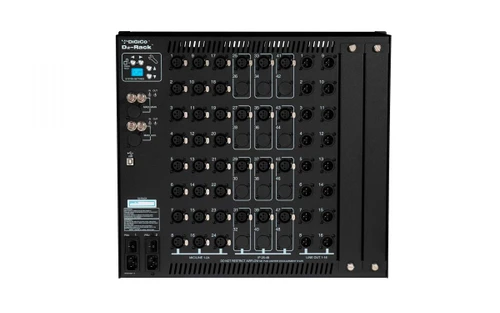
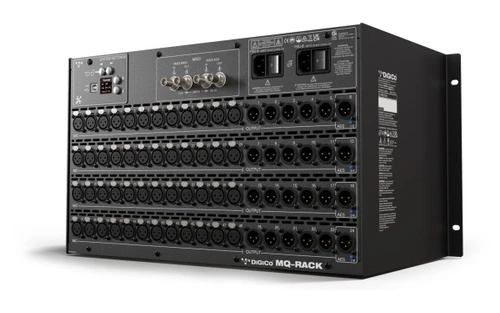
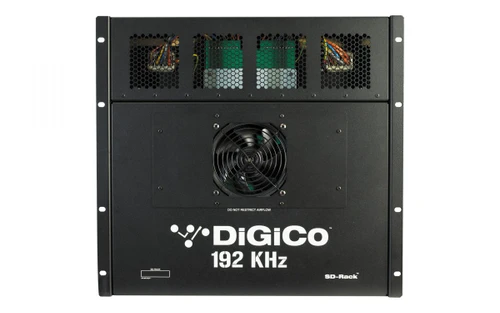
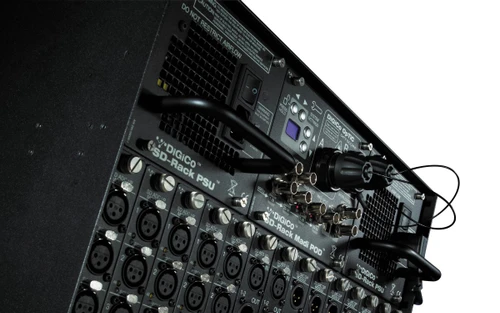
Local I/O uses the same Ultimate Stadius 32-bit converters as the 338, with 8 mic/line inputs, 8 line outputs and four stereo AES pairs. Six BNC MADI ports, two DMI slots, built-in UB MADI USB recording, optional Optocore and an optional Waves SoundGrid card cover every stage rack and plugin server workflow, from SD-Rack on Optocore to DQ-Rack on Dante through a DMI-Dante card.
The Quantum 326 sits between the 225 and the 338 and shares its frame width with the 225, so it drops into the same FOH footprint. Forefront Productions can demo, install and support the Quantum 326 for venues, churches and production companies across Australia. Pricing is on application, so get in touch for a quote tailored to your stage I/O, software options and training needs.
Specifications
| Processing | Seventh-generation FPGA Quantum engine, 96 kHz, approx 1 ms latency |
| Input channels | 128 full processing (156 with Pulse) |
| Busses | 64 aux/group (72 with Pulse), LR/LCR/LCRS/5.1 master |
| Matrix | 24 x 24 full processing |
| Control groups | 24 |
| Faders | 26 motorised 100 mm touch-sensitive (two banks of 12 plus two assignable) |
| Screens | 2 x 17 inch 1000-nit multitouch with meter bridge, 51 TFT channel displays |
| Processing extras | Mustard Processing (36 strips), Spice Rack (8 mono/4 stereo), Nodal Processing (64), 24 stereo FX |
| Converters | 32-bit Ultimate Stadius A/D and D/A |
| Local I/O | 8 x mic/line in, 8 x line out, 8 x AES I/O (4 stereo pairs) |
| MADI | 6 x BNC MADI (6 at 48 kHz or 3 at 96 kHz) |
| Expansion | 2 x DMI slots, built-in UB MADI USB, optional Optocore (dual loop), optional Waves SoundGrid |
| GPI/GPO | 16 |
| Dimensions | 1124 (W) x 805 (D) x 482 (H) mm |
| Weight | 52 kg console, approx 150 kg in flight case |
| Power | 100 to 240 V, 50 to 60 Hz, 295 VA |